
The Salesforce Conundrum: Releasing Tools No One Likes or Can Use
- Landon Stone

- Jun 10, 2024
- 3 min read
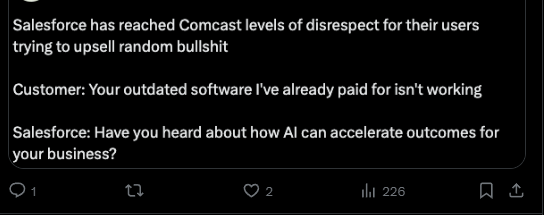
In the ever-evolving world of technology, staying ahead of the curve is crucial for any company aiming to maintain its competitive edge. Salesforce, a titan in the Customer Relationship Management (CRM) space, has long been heralded as an innovator. Yet, in recent years, a troubling trend has emerged: the release of tools that seemingly no one likes or can use effectively. Posts like the one above run rampant across platforms having data entry related conversations. What's going on with Salesforce, and how is this impacting its user base?
The Innovation Dilemma
Salesforce has built its reputation on being a forward-thinking company, constantly pushing the boundaries of what CRM software can do. However, the drive for innovation appears to have hit a snag. The company's recent product releases, such as Salesforce Einstein, Salesforce Connector, and various industry-specific solutions, have been met with lukewarm responses at best. In fact, Symbiotic Solutions began with the idea of building a Salesforce connector, which we still do, and do better than the Salesforce solution. Unfortunately, SalesForce’s resulting product is clunky, hard to use, and not actually applicable to the sales companies they represent. Why build something that still requires a salesperson going into the CRM and inputting data their way, when you could use a program they simply have to speak to and still automatically posts the results to SalesForce? That’s a user friendly solution, not a developer friendly one like SalesForce continues to pump out. Users report that these tools are either overly complex, lack intuitive design, or don't integrate seamlessly with existing workflows–ours combines the human approach and quality output with automation to ensure smooth operation.
Overwhelming Complexity
One of the primary issues with Salesforce's new tools is their complexity. While they are marketed as solutions to streamline business processes, many users find them overwhelming. The steep learning curve can be a significant barrier, especially for small to medium-sized businesses that lack the resources to invest in extensive training. For example, Salesforce Einstein, the company's artificial intelligence (AI) offering, promises to revolutionize how businesses leverage data. Yet, users frequently complain about its intricate setup and the need for specialized knowledge to utilize its full potential. Instead of simplifying tasks, it often adds another layer of complexity, making it less accessible to the average user.
Lack of Practical Application
Another critique is that many of these tools feel disconnected from practical needs. Salesforce Anywhere, which aimed to facilitate real-time collaboration, was introduced at a time when businesses were rapidly transitioning to remote work. Despite its timely release, users found it redundant and less effective than other established tools like Slack or Microsoft Teams, which already dominated the market.
Poor Integration
Seamless integration is a hallmark of effective CRM solutions. Unfortunately, many of Salesforce's recent tools struggle in this area. Businesses rely on a multitude of applications to run their operations, and any new tool must integrate smoothly with these existing systems. Salesforce's newer offerings often require significant (and expensive) customization and tweaking to fit into established workflows, which can be a deterrent for adoption.
User Feedback Ignored
A recurring theme among disgruntled users is the sense that their feedback is being ignored. Salesforce has a robust community of users who actively share their experiences and suggestions. However, the company's recent product strategies suggest a disconnect between user needs and product development. The release of tools that seem to lack practical utility or user-friendly design indicates that Salesforce might be prioritizing innovation for innovation's sake, rather than addressing real user pain points. At Symbiotic Solutions, we aim to offer these tools, implement them for you, and then give you someone to call if they need adaptation.
The Path Forward
For Salesforce to reclaim its status as a user-centric innovator, it must refocus on the fundamentals: listening to its users, simplifying its tools, and ensuring seamless integration. Here are a few steps Salesforce could take to realign its product offerings with user needs:
User-Centric Design: Prioritize intuitive design and ease of use in new tools. Conduct extensive user testing and gather feedback throughout the development process.
Practical Solutions: Focus on solving real-world problems rather than adding features for the sake of novelty. Ensure that new tools offer clear, tangible benefits that enhance productivity.
Seamless Integration: Guarantee that all new tools integrate effortlessly with existing Salesforce products and other commonly used business applications.
Continuous Improvement: Actively listen to user feedback and be willing to make iterative improvements. Show users that their input is valued and acted upon.
Transparent Communication: Keep users informed about the development process and the rationale behind new features. Transparency can build trust and foster a sense of community.
Unfortunately, this list will never realize itself if SalesForce developers continue on the path they are on. Both because they don’t care and because they want you to spend more money using the application in any channel they can create. Come to us, and you’ll get the functionality without the hassle.
